If your business depends on nearby customers walking in or calling you, showing up in local search results isn’t optional. It’s how people find you before they find your competitor.
But most small businesses get local search backward. A plumber in Andheri optimizes his site around the word “plumber.” A bakery in Bandra writes about “cakes.” Then they wonder why the phone doesn’t ring.
The real problem is simple: nobody searching those broad terms found them locally relevant.
The fix starts with local keyword research – figuring out exactly what nearby customers type into Google when they’re ready to buy, then building your website and listings around those specific words.
This guide covers what local search results actually are, why local keyword research matters, and a practical, step-by-step process any small business owner in Mumbai – or anywhere in India – can follow.
What Are Local Search Results, Exactly?
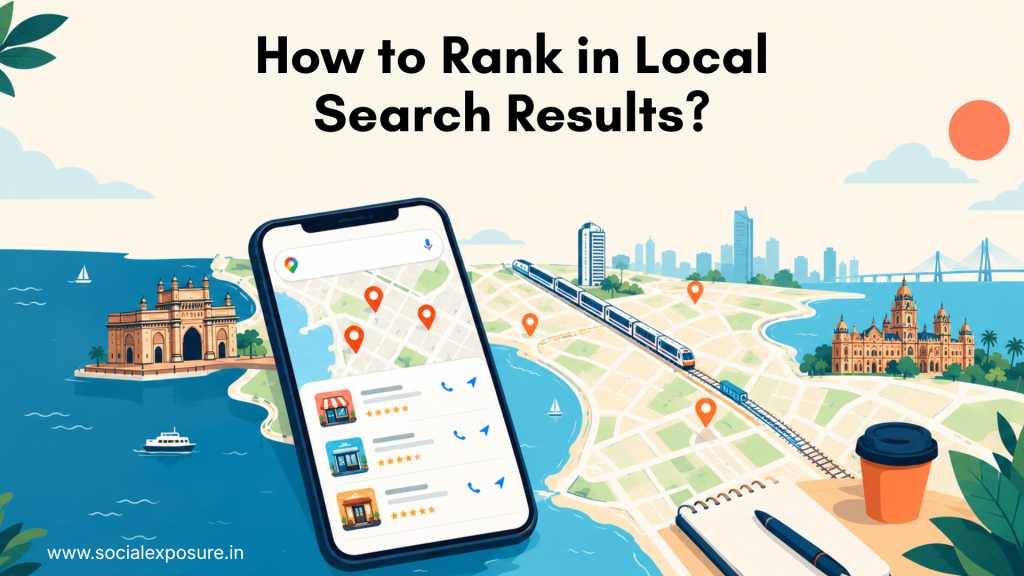
When someone searches with a location attached – either in the query itself (“dentist in Powai”) or implied by their phone’s location (“dentist near me”) – Google shows two types of results.
First, the local pack: a map with three business listings at the top. Second, the regular organic “blue link” results underneath it.
Ranking well in either counts as ranking in local search.
According to Google’s own Business Profile guidance, local ranking comes down to three factors: relevance, distance, and prominence.
Relevance is how well you match the search. Distance is how close you are to the searcher. Prominence is how well-known and trusted you are.
BrightLocal’s analysis of local ranking factors adds that relevance is shaped heavily by your business category, the keywords on your website, and what customers say about you in reviews.
That last part is exactly where keyword research comes in.
Why Local Search Visibility Matters to Small Businesses
Local searches tend to come from people close to making a decision, not just browsing.
Someone typing “emergency plumber near me” in Malad has a leak right now. They’re not comparing brands for fun – they need help today.
That intent is what makes local search results so valuable. The traffic is smaller than a national keyword’s, but it converts far better because the searcher’s need and your service overlap almost perfectly.
For a small business competing against bigger, better-funded companies, local search is one of the few places where relevance and proximity can outweigh brand size.
What Local Keyword Research Actually Means
Local keyword research is the process of identifying the specific words and phrases people in your service area use when searching for what you offer.
Then organizing those terms by intent, location, and value.
It’s different from general keyword research because location isn’t optional here – it’s baked into almost every term you’ll target.
Understanding the Types of Local Keywords
Not all local keywords work the same way. Lumping them together is where most keyword research goes wrong.
Broad keywords vs. service + location keywords
“Plumber” is broad. It’s nearly impossible for a small business to rank for or profit from, because it could mean anything, anywhere.
“Plumber in Andheri” narrows the field to a specific service in a specific place – far more winnable, and far more useful.
Push it further: “emergency plumber in Andheri” adds urgency. “Plumber near Lokhandwala” adds neighborhood precision.
"Near me" and implicit-location searches
Phrases like “AC repair near me” or “salon near me” don’t name a city at all. Google infers the location from the searcher’s device.
These searches have exploded because people expect instant, nearby answers. They usually signal high urgency too.
Neighborhood and city-level keywords
“Interior designer in Mumbai” is a city-level term – broad, competitive, hard to dominate.
“Interior designer in Powai” is neighborhood-level. Smaller in volume, but often much easier to rank for, and it matches exactly where you work.
Service-area keywords
If you run a pest control or home-cleaning service that travels to customers rather than operating from a storefront, your keywords should reflect the actual suburbs you cover – Thane, Navi Mumbai, Vashi – not just your registered office address.
Informational, transactional, and branded local searches
“How much does home painting cost in Mumbai” is informational. The searcher is still researching.
“Home painting service Mumbai free quote” is transactional. They’re ready to act.
“[Your business name] reviews” is branded. They already know you and are just checking you out.
Each of these deserves different content.
How to Perform Local Keyword Research, Step by Step
1. Start with your services, not a tool.
List every service you offer, and every locality, suburb, or city you genuinely serve.
2. Think like your customer, not like a marketer.
A homeowner in Chembur doesn’t search “residential pest management solutions.” They search “cockroach treatment near me.”
Read your own reviews and customer WhatsApp messages for the exact words people use.
3. Mine Google’s own signals.
Type your seed terms into Google and note the autocomplete suggestions, the “People also ask” questions, and the related searches at the bottom.
These come directly from how real people in your area actually search.
4. Bring in a keyword tool for volume and difficulty data.
Tools like Semrush, Google Keyword Planner, or Google Trends can show you roughly how often a term is searched, and how competitive it is.
Use this once you already have a strong list – let the data refine it, not create it from scratch.
5. Study your local competitors.
Look at the businesses ranking in the local pack for your core terms. What services do their pages emphasize? Where are the gaps you could fill better?
6. Evaluate and prioritize before you build anything.
This step saves the most wasted effort, and it’s the one most guides skip entirely.
Why Search Volume Alone Should Never Decide Your Keywords
A keyword with high volume but low relevance is worthless to a small business. Before targeting any local keyword, weigh it against:
Relevance – does it match a service you actually, profitably offer?
Search intent – is the searcher informational, comparing options, or ready to hire?
Location match – is this an area you genuinely serve, or one you’d have to stretch to reach?
Competition – can a small site realistically compete for this term?
Demand – is anyone actually searching it?
Business value and conversion potential – would ranking for it lead to real inquiries?
A wedding photographer in Mumbai should generally skip “photographer in Mumbai” – too broad, too competitive.
Instead, prioritize something like “candid wedding photographer in Bandra” or “pre-wedding shoot Alibaug,” where intent and relevance are far stronger, even if the raw search volume is smaller.
Turning Local Keywords Into Local Search Visibility
Keyword research only pays off once it shapes what you actually publish. Use your prioritized list to inform:
Service pages – one page per core service, written around the terms customers actually use, following sound on-page SEO practices for titles, headings, and structure.
Location or service-area pages – only for areas you genuinely operate in, never invented just to chase volume.
Google Business Profile – your business description, categories, and posts should reflect the same language and services your keyword research surfaced.
Titles, meta descriptions, and headings – work in primary local terms naturally, without forcing them into every line.
FAQs and blog content – answer the informational questions your research turned up. The what-is-SEO breakdown explains how this kind of foundational content supports rankings.
Reviews and citations – encourage reviews that naturally mention your service and locality. This supports the off-page trust signals covered in this guide to off-page SEO.
Technical basics – fast-loading, mobile-friendly pages matter for local rankings too, as explained in this technical SEO overview.
Every use of a keyword should read naturally. Google’s own SEO Starter Guide is explicit that content should be written for people first, not search engines.
Common Local Keyword Research Mistakes
Targeting only broad, citywide terms and ignoring neighborhood-level opportunities
Choosing keywords by volume alone, without checking intent or relevance
Copying competitor keywords without asking whether they actually convert
Creating location pages for cities or suburbs you don’t serve, just because the keyword looks appealing
Keyword stuffing titles, headings, or Google Business Profile fields
Ignoring the actual words customers use in reviews and phone calls
Treating every keyword as equally valuable instead of prioritizing by business impact
A Simple Local Keyword Research Workflow
List your services and your true service area.
Collect the exact phrases customers already use.
Expand that list with Google autocomplete, “People also ask,” and a keyword tool.
Score each term for relevance, intent, competition, and business value.
Assign priority keywords to specific pages – one primary term per page.
Update your website, service pages, and Google Business Profile to match.
Revisit the list every few months as your services or reviews change.
Conclusion
Ranking in local search results isn’t about chasing the biggest keyword you can find. It’s about matching the specific words real customers near you are already searching, with content that genuinely serves that search.
Do the keyword research properly once, organize it by intent and value, and use it to guide your website and Google Business Profile honestly. The visibility follows from there.
This is the exact process our team runs for local businesses across Mumbai and if you’d rather have us map it out and execute it for you, Social Exposure’s SEO team is here to help.